
Op-ed · 2019
No Kaddish for Jersey City
Translated from the French. Original: op-ed by David Benaym, December 2019 · French version
 Op-ed
Op-edOutrage, hatred, anger? How do we rekindle the flame that drives struggle and commitment? Thirteen months apart, American Jewish communities found themselves confronted with what, for more than 50 years, they had thought was the problem of their cousins across the Atlantic. American Jewish organisations used to fight antisemitism by way of donations, outraged to see that their families in Belgium, France or England still had to endure hatred of the Jew.
The shock was terrible, on an ordinary autumn Shabbat in Pittsburgh. The awakening of October 27, 2018. When a white supremacist attacked the ‘Tree of Life’ synagogue (with all the irony of the name) killing 11 worshippers in what would be the deadliest antisemitic attack in the United States. The collective outrage was instant. That Saturday evening, Jewish communities around the world reacted on social networks, mass digital indignation. Can millions of posts replace a human tide on the Place de la République? That evening, only the Jews of Pittsburgh would gather, candles in hand, to mourn their dead.
Only the community mobilised; it alone seemed affected. It was not Americans who had been killed, but Jewish worshippers in their place of worship. No indignation from the population, except on the evening news, “another mass shooting”, gun ownership is blamed, “thoughts and prayers” are invoked as after each of these attacks with automatic weapons. A ritual that has become ordinary. Never did the population march, as it did after the desecration of the Carpentras cemetery in 1990, when hundreds of thousands of people marched through the streets of Paris in indignation. Americans have not known the million citizens gathering under “Je suis Charlie” banners. Here communities mourn their dead behind closed doors. The wounds of their neighbours cause only local bleeding, quickly clotted, swiftly hidden under a sticking plaster so as not to think about it.
Gays, Black people or Jews, all minorities, all collateral victims of ordinary hatred. After Orlando, only the gay community mobilised to mourn its dead in the aftermath of the attack on the LGBT club. 49 people fell under the tearing bullets of a weapon of mass destruction in the name of the Islamic State. Another city, another crime scene: 9 Black Americans murdered in their Charleston church in the middle of Sunday service, the same modus operandi, and always the same absence of national reaction, the same ultra-local, ultra-communal mourning.
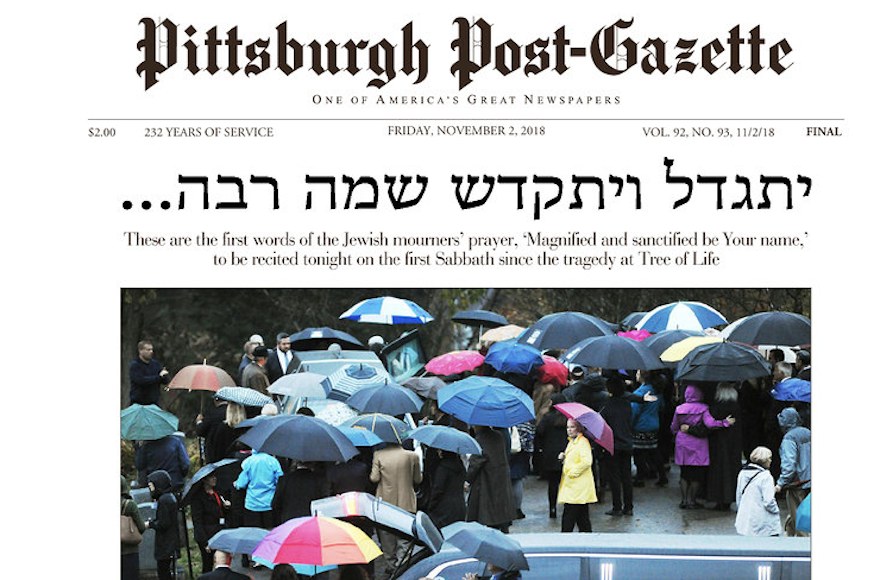
And since then, the situation has worsened. The antisemitic awakening is spreading across the United States. Community leaders do invite speakers, as on that Saturday in November in Manhattan when they tried to make worshippers aware of how to act against hatred. A heavily equipped cop paired with a security guard asks questions at the entrance, something new. Even brand-new cameras scan passers-by. But when another antisemitic attack killed again on December 11, a few kilometres away, in Jersey City, even the Kaddish that had made the front page of the Pittsburgh daily 13 months earlier had disappeared. The antisemitic attack on the other side of the Hudson River does not even reach the 3 million Jews of New York City.
The anaesthesia has taken effect. Numb to attacks even within their own family. The observation is terrible, pessimistic, and yet optimism must remain the rule. The flame is rekindling. It lives on in young people who thirst for life, more aware and confident in their own future. This generation that thrives online is getting active: it acts on American campuses to fight BDS, gets involved in politics by lowering the average age of Congress in 2018 through the election of 25 new members under 40, and is getting ready to campaign to eradicate the Second Amendment in its current form. The hashtag generation is arriving; it operates in an unorthodox way, in a new digital tradition, but effectively. Behind the code #MarchForOurLives, it will bring together millions across the United States for the March for Our Lives. A first in the 21st century. It is to them that we must entrust action and hope for this world that belongs to them. [Véimérou, Amen].
David Benaym is a journalist specialising in the United States, New York correspondent for i24NEWS
Caption of the Pittsburgh Post-Gazette:
After the attack on the Tree of Life Synagogue, in a moving tribute to the victims, the Pittsburgh daily printed the first words of the Kaddish on its front page.
Caption of the Daily News:
A year after Pittsburgh, the Jersey City attack is described as an outburst of hatred, “Rampage”, without singling out its antisemitic nature.